
Which ashwagandha is actually legit: 5 label checks before you buy
Hundreds of ashwagandha products, all claiming to be premium. Five quick label checks tell you which one is worth taking, and why the right dose depends on the extract, not the milligrams.

On this page
Search "ashwagandha" and you'll find hundreds of options: 300 mg, 600 mg, even 1,000 mg, priced anywhere from ₹199 to ₹1,999. Almost every label says "pure" or "premium". So which one is actually worth taking? Five checks on the label answer that. By the end of this guide, you'll be able to judge any ashwagandha in under a minute.
- Ashwagandha quality comes down to five label checks: plant part, standardisation, human trials, the right dose, and daily use.
- Most ashwagandha trials used 250 to 600 mg a day, but milligrams don't carry over from one extract to another.
- The right dose is the dose that exact extract was tested at in humans.
- Ashwa30™ passes all five checks: a root extract tested in placebo-controlled trials at 30 mg a day.
Why ashwagandha is so hard to shop for
Ashwagandha (Withania somnifera) is one plant, but the extracts made from it are very different products. Researchers reviewing the evidence point to significant variability in the extracts used in trials: some are root-only, others combine root and leaf, and doses ranged from 250 to 600 mg a day. [1]
That's why two bottles that both say "ashwagandha 500 mg" can contain very different things. The good news: five checks, applied in order, cut through it.

Check 1: Is it made from the root?
The root is the part of ashwagandha traditionally used in Ayurveda, and root and leaf have different chemical profiles. Products made from root and leaf, or from leaf alone, aren't the same as root extracts, even when the milligrams match.
What to look for: "root extract" on the label. If the plant part isn't stated, you don't know what you're buying.
Check 2: Is the withanolide percentage on the label?
Withanolides are the natural compounds most closely studied in ashwagandha root. A quality extract is standardised: tested so every batch contains a set percentage of withanolides.
Plain ashwagandha powder usually isn't standardised, so its strength can vary from batch to batch. What to look for: a withanolide percentage, such as "standardised to 15% withanolides". No percentage means no way to know how strong it is.
Check 3: Has this exact extract been tested in humans?
This is the check most products fail. The best ashwagandha extracts are named ingredients with their own clinical trials. Generic powders tend to borrow research done on someone else's extract.
What to look for: a named extract with randomised, double-blind, placebo-controlled trials, ideally published in peer-reviewed journals you can look up on PubMed.
Check 4: Does the dose match the trial?
Here's where most people get misled. Because extracts differ so much, a milligram of one isn't a milligram of another. The only dose that tells you anything is the dose that extract was tested at.
- If an extract was tested at 600 mg, a 300 mg capsule is half the studied dose.
- If an extract was tested at 30 mg, 30 mg is exactly right, and 600 mg isn't "20 times better".
"The right ashwagandha dose is the dose that was tested."
Check 5: Will you take it daily, for weeks?
Ashwagandha isn't a quick fix. In clinical trials, people took it every day for 4 to 8 weeks before results were measured. [1, 2] The best extract won't help if it sits in the cabinet.
What to look for: a format you'll actually stick with, like a once-a-day routine with breakfast or lunch.
Putting the checklist to work: Ashwa30™
Now let's run one extract through all five checks. Ashwa30™ is the ashwagandha we chose for Drivon, and here's how it scores.

- Root: a 100% root extract. [3]
- Standardised, twice over: above 15% withanolides, measured by the official pharmacopoeia method, plus above 15% of an ATP-active fraction, a second group of root compounds linked to energy production in cells. [3]
- Tested in humans: two randomised, double-blind, placebo-controlled trials. [1, 2]
- Dose: developed to work at a low dose and tested at 30 mg a day, which is why 30 mg is the right amount, not a small one. [3]
What the Ashwa30™ trials found at 30 mg a day
Stress over four weeks. 60 adults with self-reported stress took 30 mg of Ashwa30™ or a placebo every day for 28 days. [1]
- Stress scores fell 46% with Ashwa30™, compared with 33% on placebo.
- Daily stress ratings were lower in the Ashwa30™ group across the trial.
- During a standard stress test (hand in ice water while being observed), the Ashwa30™ group rated their stress lower, and their salivary cortisol stayed relatively steady, while it rose in the placebo group.
Endurance over eight weeks. Healthy adults took 30 mg of Ashwa30™ or a placebo daily. [2]
- VO2 max improved compared with placebo: a standard measure of cardio fitness.
- Lactic acid during exercise was lower, and ratings of perceived effort and fatigue improved.

Both trials reported that Ashwa30™ was well tolerated, with no serious or treatment-related adverse events. [1, 2] They're also modest in size, and the stress trial's authors describe their results as promising findings that larger studies should build on. That's the honest picture: a well-designed, growing body of evidence at 30 mg.
Where Drivon fits
Every serving of Drivon gives you 30 mg of Ashwa30™, the dose used in its human trials: a root extract standardised to 15% withanolides. It's combined with 200 mg of L-theanine, saffron extract, magnesium aspartate and vitamin B6, with every dose on the label and no proprietary blends.
Drivon is caffeine-free and made with Ashwa30™, clinically studied to support healthy cortisol levels and a balanced stress response through demanding workdays, taken once a day with breakfast or lunch: check 5, made easy.
- 30 mg Ashwa30™, the dose used in its human trials
- Root extract, 15% withanolides, with L-theanine and saffron extract
- Money-back guarantee on your first pack
Frequently asked questions
Is 30 mg of ashwagandha enough?
For Ashwa30™, yes: 30 mg a day is the dose it was tested at in placebo-controlled human trials. [1, 2] That doesn't apply to other extracts. 30 mg of a different ashwagandha extract wouldn't be the same thing.
Is ashwagandha powder as good as an extract?
Plain root powder usually isn't standardised, so its withanolide content can vary, and it can't point to trials of its own. A standardised, clinically studied extract tells you exactly what you're getting and what dose was tested.
What are withanolides?
Withanolides are natural compounds found in ashwagandha root. Extracts are standardised to a withanolide percentage so you know how concentrated they are. Ashwa30™ is standardised to over 15%. [3]
How long should I take ashwagandha?
In the Ashwa30™ trials, people took it every day for 4 to 8 weeks before results were measured. [1, 2] Ashwagandha is meant for consistent daily use, and individual responses vary.
Is it safe to take ashwagandha every day?
In both Ashwa30™ trials, daily use was well tolerated, with no serious adverse events. [1, 2] If you're pregnant or nursing, have a thyroid or autoimmune condition, or take medication, check with a doctor first.
Sources
- Lopresti AL, et al. An examination into the anti-stress and anti-fatigue effects of an ashwagandha extract (Ashwa.30™) in stressed adults: a randomised, double-blind, placebo-controlled trial. Advances in Therapy. 2026. PubMed 42593642
- Prajapati H, et al. Efficacy and safety of low-dose ashwagandha supplementation on exercise endurance: a randomized, placebo-controlled, double-blind, clinical trial. Phytotherapy Research. 2026. PubMed 41846233
- Lakshmikanthan S, et al. Ashwa.30: a bioactive-optimized ashwagandha extract for clinically validated low-dose efficacy. Alternative Therapies in Health and Medicine. 2025. PubMed 40742825
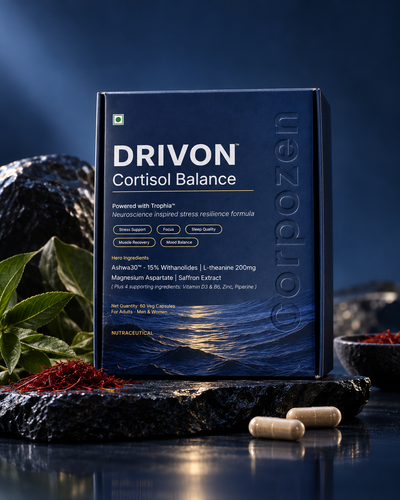
- 200 mg L-theanine, the studied dose, in every serving
- With Ashwa30™, saffron extract and magnesium · caffeine-free
- Money-back guarantee on your first pack
 From Corpozen
Drivon Cortisol Balance
With Ashwa30™, clinically studied to support healthy cortisol levels, plus 200 mg L-theanine for calm focus in every serving.
See what's inside →
Claims are based on scientific literature on the ingredients used.
For general information only. Not a medical test or a substitute for medical advice. Consult a doctor if you are pregnant, nursing, on medication or have a medical condition.