
Low vitamin D in a sunny country: Why your level keeps dropping, even after the 60K sachets
Most Indian professionals test low in vitamin D, in one of the sunniest countries on earth. Why the sun isn't reaching you, what the number on your report means, why levels slip after the 60K sachets, and how to keep them steady.

On this page
Your annual health check comes back. Vitamin D: 14 ng/mL, flagged in red. Your doctor prescribes a 60,000 IU sachet once a week for eight weeks. You finish the course, the next report looks fine, and a year later the number has slid right back down. You live in one of the sunniest countries on earth. So what's going on?
You're not alone, and it isn't bad luck. It comes down to how your body makes vitamin D, when you're actually in the sun, and what happens after a big dose wears off.
- In a Mumbai study of healthy 25 to 35-year-olds, 70% had low vitamin D, despite year-round sunshine.
- Your skin makes vitamin D mainly between 11 am and 2 pm, the hours most professionals spend indoors.
- Big doses raise a low number, but the level falls again within weeks. Steady daily intake keeps it up.
- Get more from every dose: choose D3, take it with a meal, and keep your magnesium up.
Vitamin D is made in your skin, not on your plate
Most vitamins come from food. Vitamin D mostly doesn't. When UVB rays from the sun hit your skin, they turn a cholesterol-like compound into vitamin D3. [5] Your liver then converts it into 25-hydroxyvitamin D, the form your blood test measures, and your kidneys activate it when your body needs it.
Very few foods contain much vitamin D, especially in a mostly vegetarian Indian diet. So for most people, it's the sun or a supplement.
Why it matters:
- Bones: vitamin D helps your body absorb calcium, the raw material for strong bones. [9]
- Immune function: your immune cells carry vitamin D receptors, and some can activate vitamin D themselves. [4]
Sunny country, low vitamin D: the numbers
This isn't a few unlucky people. A review of 65 studies across South Asia found that 67% of adults in India were deficient. [1]
Closer to home, a study of 1,137 healthy 25 to 35-year-olds in Mumbai found an average level of 17.4 ng/mL, with 70% below 20 ng/mL. [2]
And your job matters. A review of 71 studies across many professions found that 78% of indoor workers were deficient, compared with 48% of outdoor workers. [3] The more of your day you spend under office lights, the less vitamin D your skin gets to make.
Why the sun isn't reaching your skin
1. You're indoors during the hours that count. In India, the UVB that makes vitamin D peaks between about 11 am and 2 pm, all year round. [6, 7] Morning and evening sun feels pleasant but carries much less UVB. For most professionals, those midday hours are spent in meetings.
2. Your skin needs longer. More melanin, sunscreen and covered-up clothing all cut how much vitamin D the skin makes from the same sunlight. [5] Indian skin needs more time in the sun than fair skin to make the same amount.
3. Smog filters the sun. In Delhi, children living in a heavily polluted area had less than half the vitamin D of children in a less polluted part of the city: 12.4 vs 27.1 ng/mL. [8]
4. North Indian winters barely count. In a winter study of schoolchildren in India, 30 minutes of midday sun a day for four weeks didn't raise their levels at all. [7] In November in Agra, the skin made almost no vitamin D. [5]

Reading your report: what the number means
The test is called 25-hydroxyvitamin D (sometimes "25-OH vitamin D"). Most Indian labs report it in ng/mL and use these bands, from the Endocrine Society's guideline: [9]
| Your result | What labs usually call it |
|---|---|
| Below 20 ng/mL | Deficient |
| 20 to 29 ng/mL | Insufficient |
| 30 ng/mL and above | Sufficient |
If your report uses nmol/L, divide by 2.5 to get ng/mL. Experts still debate the ideal target, so if your level is low, your doctor is the right person to set your dose.
Why your level slips after the sachets
The 60,000 IU sachets do their job: a large dose raises a low level quickly. The problem is what happens next.
The form of vitamin D your test measures has a half-life of about 15 days. [10] So after the last sachet, your level starts falling within weeks. In one trial of a single very large dose, levels peaked at one month and were already lower by three. [12] And nothing about your routine changed: you're still indoors at noon.
Bigger isn't automatically better either. In a trial of older adults, 60,000 IU once a month raised levels more than 24,000 IU, but the higher-dose group had more falls, not fewer. [13] And in Kashmir, doctors reported ten adults with vitamin D toxicity, all of whom had taken very high doses. [14]

"Think of the sachets as filling the tank. Daily vitamin D is what stops it from draining."
How to get more from every dose
Whatever you take, these four habits help more of it reach your blood.
1. Choose D3 over D2. A meta-analysis of head-to-head trials found that vitamin D3 raised blood levels more effectively than vitamin D2. [15] Check your label: D3 is often written as "cholecalciferol", D2 as "ergocalciferol".
2. Take it with a meal that has some fat. Vitamin D is fat-soluble. When people took it with a meal containing fat, 32% more was absorbed than with a fat-free meal. [16] In another study, people whose levels weren't rising on supplements switched to taking them with their largest meal, and their levels rose by about 50%. [17] Breakfast with eggs, paneer, curd or a little ghee works well.
3. Keep your magnesium up. The enzymes that convert vitamin D into the forms your body uses depend on magnesium. In a randomised trial, magnesium supplements helped bring vitamin D levels towards a healthy middle range. [18]
4. Take it every day. Steady daily intake keeps your level even, rather than rising and falling. [10, 11]

Where Drivon fits
Every serving of Drivon contains 600 IU of vitamin D3, the daily amount ICMR-NIN recommends for Indian adults. [19] It's a steady daily amount, not a megadose, designed for everyday use, not to replace a course your doctor prescribes.
Our D3 is plant-based, from lichen, rather than lanolin from sheep's wool, which is where most D3 comes from. It's taken once a day with breakfast or lunch, so it arrives with a meal, and it sits in the same capsule as magnesium aspartate. Vitamin D3 supports normal immune function and bone health, alongside Drivon's core four for a healthy stress response.
- 600 IU vitamin D3, the ICMR daily recommended amount
- Plant-based D3 from lichen, with magnesium aspartate
- Money-back guarantee on your first pack
Frequently asked questions
Why is vitamin D deficiency so common in India?
Mostly timing and lifestyle. Your skin makes vitamin D mainly between 11 am and 2 pm, when most professionals are indoors. [6] Darker skin, covered clothing, sunscreen and pollution all cut how much the skin makes, and few Indian foods contain much vitamin D. [5, 8]
Is 600 IU of vitamin D3 a day enough?
600 IU is the daily amount ICMR-NIN recommends for Indian adults, meant to maintain healthy levels. [19] If your test shows you're deficient, your doctor may prescribe a higher dose first. A daily amount like 600 IU is what helps keep your level steady afterwards.
What is the best time to take vitamin D?
With a meal that contains some fat, at any time of day that you'll stick to. Fat in the meal increased absorption by 32%, and taking it with the largest meal raised levels by about 50% in people whose levels weren't rising. [16, 17]
Is D3 better than D2?
Yes, for raising blood levels. A meta-analysis of head-to-head trials found vitamin D3 raised blood levels more effectively than D2. [15] Check the label for "D3" or "cholecalciferol".
Is vitamin D3 from lichen the same as regular D3?
Yes, it's the same molecule, cholecalciferol. The difference is the source: most D3 is made from lanolin in sheep's wool, while lichen D3 is plant-based and suitable for vegetarians and vegans.
Can I take Drivon while on 60,000 IU sachets?
Ask your doctor first and add up your daily total. Drivon's 600 IU is a daily amount, designed for keeping levels steady rather than raising a deficient level.
Sources
- Siddiqee MH, et al. High prevalence of vitamin D deficiency among the South Asian adults: a systematic review and meta-analysis. BMC Public Health. 2021. PubMed 34627207
- Shivane VK, et al. High prevalence of hypovitaminosis D in young healthy adults from the western part of India. Postgraduate Medical Journal. 2011. PubMed 21508424
- Sowah D, et al. Vitamin D levels and deficiency with different occupations: a systematic review. BMC Public Health. 2017. PubMed 28637448
- Aranow C. Vitamin D and the immune system. Journal of Investigative Medicine. 2011. PubMed 21527855
- Holick MF. Vitamin D and skin physiology: a D-lightful story. Journal of Bone and Mineral Research. 2007. PubMed 18290718
- Harinarayan CV, et al. Vitamin D status and sun exposure in India. Dermato-Endocrinology. 2013. PubMed 24494046
- Marwaha RK, et al. Regional and seasonal variations in ultraviolet B irradiation and vitamin D synthesis in India. Osteoporosis International. 2016. PubMed 26630977
- Agarwal KS, et al. The impact of atmospheric pollution on vitamin D status of infants and toddlers in Delhi, India. Archives of Disease in Childhood. 2002. PubMed 12138058
- Holick MF, et al. Evaluation, treatment, and prevention of vitamin D deficiency: an Endocrine Society clinical practice guideline. Journal of Clinical Endocrinology & Metabolism. 2011. PubMed 21646368
- Jones G. Pharmacokinetics of vitamin D toxicity. American Journal of Clinical Nutrition. 2008. PubMed 18689406
- Martineau AR, et al. Vitamin D supplementation to prevent acute respiratory tract infections: systematic review and meta-analysis of individual participant data. BMJ. 2017. PubMed 28202713
- Sanders KM, et al. Annual high-dose oral vitamin D and falls and fractures in older women: a randomized controlled trial. JAMA. 2010. PubMed 20460620
- Bischoff-Ferrari HA, et al. Monthly high-dose vitamin D treatment for the prevention of functional decline: a randomized clinical trial. JAMA Internal Medicine. 2016. PubMed 26747333
- Koul PA, et al. Vitamin D toxicity in adults: a case series from an area with endemic hypovitaminosis D. Oman Medical Journal. 2011. PubMed 22043417
- Tripkovic L, et al. Comparison of vitamin D2 and vitamin D3 supplementation in raising serum 25-hydroxyvitamin D status: a systematic review and meta-analysis. American Journal of Clinical Nutrition. 2012. PubMed 22552031
- Dawson-Hughes B, et al. Dietary fat increases vitamin D-3 absorption. Journal of the Academy of Nutrition and Dietetics. 2015. PubMed 25441954
- Mulligan GB, Licata A. Taking vitamin D with the largest meal improves absorption and results in higher serum levels of 25-hydroxyvitamin D. Journal of Bone and Mineral Research. 2010. PubMed 20200983
- Dai Q, et al. Magnesium status and supplementation influence vitamin D status and metabolism: results from a randomized trial. American Journal of Clinical Nutrition. 2018. PubMed 30541089
- ICMR-National Institute of Nutrition. Nutrient Requirements for Indians: Recommended Dietary Allowances and Estimated Average Requirements (brief note). 2020. nin.res.in
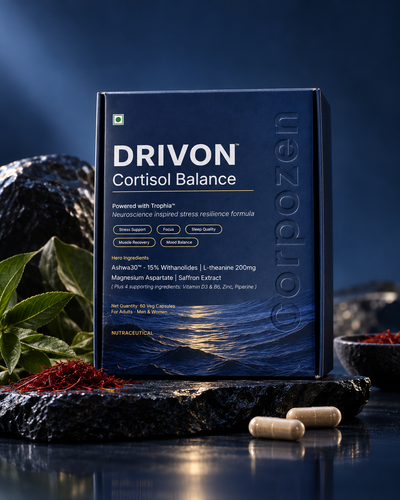
- 200 mg L-theanine, the studied dose, in every serving
- With Ashwa30™, saffron extract and magnesium · caffeine-free
- Money-back guarantee on your first pack
 From Corpozen
Drivon Cortisol Balance
With Ashwa30™, clinically studied to support healthy cortisol levels, plus 200 mg L-theanine for calm focus in every serving.
See what's inside →
Claims are based on scientific literature on the ingredients used.
For general information only. Not a medical test or a substitute for medical advice. Consult a doctor if you are pregnant, nursing, on medication or have a medical condition.