
Cortisol, adrenaline and your daily rhythm: Why you're wiped out at 4 pm and wired at midnight
A plain-language guide to your stress rhythm: what your body clock is, what cortisol actually does, how it differs from adrenaline, and why demanding days leave you wiped out at 4 pm and wired at midnight.

On this page
You got through back-to-back calls on two coffees and a protein bar. At 4 pm you could have slept at your desk. Now it's 11:40, the laptop is closed, the lights are off, and your brain has decided this is the perfect time to re-plan next quarter.
Then the alarm goes at 7, and you're tired again. It feels like your body is working against you. It isn't. It's doing exactly what your day told it to do, just a few hours late.
If this is your week, you're not imagining it
"Tired but wired" isn't a medical term. It's what people call this pattern, and if you're in a demanding job, it's probably familiar:
- A wall at 3 or 4 pm, then a second wind after 9.
- Coffee after lunch to get through, and sometimes another one at 5.
- Work replaying in bed: the email you didn't send, tomorrow's first call.
- Seven hours of sleep, and you still wake up tired.
None of these is a diagnosis, and if they're constant or getting worse, talk to a doctor. For most driven professionals, though, they have a simple, physical explanation.
A 2-minute primer: your body runs on a clock
Your master clock
Deep in your brain sits a cluster of cells that works as a master clock, running on a cycle of about 24 hours. It keeps time mainly using light, and it coordinates smaller clocks in almost every organ, including the adrenal glands that make your stress hormones. [1] That's why your body doesn't just react to your day; it anticipates it.
Cortisol: your daytime hormone, not your enemy
Cortisol has a bad reputation, but your body needs it. It helps manage your energy, alertness, immune activity and thinking. [1] It's released in pulses, and the size of those pulses rises and falls to make a daily wave: [2]
- Morning: a sharp rise in the first 30 to 45 minutes after you wake, to get you going. [3]
- Through the day: a slow, steady decline.
- Evening: its lowest point, so you can switch off. [1]
Short rises in cortisol are useful; they help you rise to a challenge. The trouble starts when it stays raised for too long, day after day. [2]
Cortisol vs adrenaline: the sprinter and the marathon runner
Your body actually has two stress systems, and they work on very different timescales. [4]

| Adrenaline | Cortisol | |
|---|---|---|
| Think of it as | The sprinter | The marathon runner |
| Speed | Seconds | Minutes, and lasts for hours |
| What it does | Heart rate, alertness, the "jolt" | Energy, focus and recovery across the day |
| Daily rhythm | Spikes with each stressor | A 24-hour wave set by your master clock |
The email that makes your heart jump is adrenaline. The flat 4 pm and the wired midnight are mostly about cortisol's rhythm, and that's why a single calm moment rarely fixes them.
Melatonin: the night shift
As cortisol falls in the evening, melatonin rises to signal night. The two work like a relay. Light is what tells the master clock when to hand over. [1, 5]
What pushes your rhythm late
On long, high-pressure days, the cortisol curve can flatten: less lift in the morning, less wind-down at night. Researchers have linked flatter daily cortisol rhythms with poorer wellbeing. [6] In a busy professional's day, three things usually push it late.

1. Your afternoon coffee is still working at bedtime
All day, a chemical called adenosine builds up in your brain. It's what makes you feel tired, and it's the signal that lets you fall asleep. Caffeine works by blocking that signal. It doesn't give you energy; it hides your tiredness.
The catch is how long it lasts. Caffeine taken even 6 hours before bed still disrupted sleep in a controlled study. [7] And caffeine does more than keep you awake: a double espresso 3 hours before bed delayed the body clock by about 40 minutes, nearly half the effect of three hours of bright light. [8] How fast you clear caffeine also varies widely from person to person, partly because of your genes, so the coffee your colleague shrugs off may still be in your system at midnight. [9]
2. Your brain hasn't left work
Unfinished tasks don't stay at the office. Research shows that open goals keep pulling at your attention until you either finish them or make a specific plan for them. [10] And that mental replaying isn't harmless: worry and rumination keep the body's stress response physically active, long after the stressful moment has passed. [11]
That's why your heart can feel like it's still in the meeting while you're lying in the dark.
3. Your lights are telling your brain it's daytime
Your brain uses light to decide what time it is. In one study, ordinary room light in the evening delayed the start of melatonin, the hormone that tells your body it's night, in 99% of people, and shortened it by about 90 minutes. [5]
Screens add to it. People who read on a light-emitting screen before bed took longer to fall asleep, had a later body clock, and were less alert the next morning than people who read a printed book. [12] That's the "seven hours of sleep and still tired" part.
"Caffeine doesn't give you energy. It borrows it from tonight."
Three resets that pull your rhythm back
Each reset answers one of the three causes above. None needs an app, a gadget or a two-hour routine.

Reset 1: Move your caffeine cut-off to 2 pm
Treat caffeine like a meeting with a hard stop. With an 11 pm bedtime, a 2 pm cut-off gives you more than the 6-hour gap the research supports, with a margin for slower metabolisers. [7, 9] For the afternoon slump, swap the 4 pm coffee for something that supports focus without blocking your sleep signal; here's what 31 trials show about L-theanine.
Reset 2: Close the loops before you close the laptop
Take 10 minutes at the end of your workday. For every open item, write the next action and when you'll do it. Then write tomorrow's first task in detail.
In a sleep-lab study, people who spent five minutes writing a specific to-do list fell asleep faster than people who wrote about what they'd already done; the more specific the list, the faster they fell asleep. [13] A plan tells your brain it can stop holding the task. [10]
Reset 3: Dim the last hour
In the hour before bed, switch from overhead lights to warm, low lamps, and put the phone and laptop away. If you read, read paper. It's the simplest way to stop telling your brain it's still daytime. [5, 12]
Why the resets slip on the weeks you need them most
Here's the honest part. These resets work best when they're consistent, and consistency is hardest when work is at its worst: the launch week, the quarter-end, the month of late calls. That's when the 2 pm coffee becomes a 6 pm coffee and the shutdown list doesn't happen.
That's why a daily foundation helps: something that takes no willpower, supports your stress response on the hard days, and makes the resets easier to keep.
Where Drivon fits
Drivon is made with Ashwa30™, clinically studied to support healthy cortisol levels and a balanced stress response. It's caffeine-free and taken once a day with breakfast or lunch, so it works with your 2 pm cut-off, not against it.
- 30 mg Ashwa30™: in its 4-week trial, cortisol stayed relatively steady during a stress test while it rose with placebo. [14] How to judge an ashwagandha →
- 200 mg L-theanine: supports calm, steady focus, with no caffeine. The evidence →
- Magnesium aspartate: a well-absorbed, daytime-friendly form. Why this form →
- 30 mg saffron extract: supports mood balance, and has been studied to support sleep quality. What the trials show →
- Ashwa30™, clinically studied to support healthy cortisol levels
- Caffeine-free, so it fits your 2 pm caffeine cut-off
- Money-back guarantee on your first pack
Frequently asked questions
Why am I exhausted all day but wide awake at night?
Your stress response follows a daily rhythm: high in the morning, low at night. [3] Afternoon caffeine, unfinished work and bright evening light can all push that rhythm later, so you feel flat in the afternoon and alert at bedtime. [5, 7, 11]
Why do I wake up tired after seven hours of sleep?
Timing matters as well as hours. Evening light and screens delayed the body clock in studies, and people who read on screens before bed were less alert the next morning. [5, 12] Late caffeine can also disrupt sleep in ways you don't notice. [7]
Does caffeine affect my sleep even if I fall asleep fine?
It can. In a controlled study, a double espresso 3 hours before bed delayed the body clock by about 40 minutes, and in another, caffeine taken 6 hours before bed still disrupted sleep. [7, 8]
Does "tired but wired" mean my cortisol is too high?
Not necessarily, and only a doctor can test it. Research shows cortisol follows a daily curve that can flatten under long-running pressure. [3, 6] If you feel this way most days, it's worth discussing with a doctor.
Can a supplement fix tired but wired?
No supplement replaces sleep and a sensible routine. Drivon is made with Ashwa30™, clinically studied to support healthy cortisol levels, and it's designed to work alongside the three resets, taken once a day with breakfast or lunch.
Sources
- Oster H, et al. The functional and clinical significance of the 24-hour rhythm of circulating glucocorticoids. Endocrine Reviews. 2017. PubMed 27749086
- Russell G, Lightman S. The human stress response. Nature Reviews Endocrinology. 2019. PubMed 31249398
- Stalder T, et al. Assessment of the cortisol awakening response: expert consensus guidelines. Psychoneuroendocrinology. 2016. PubMed 26563991
- Godoy LD, et al. A comprehensive overview on stress neurobiology: basic concepts and clinical implications. Frontiers in Behavioral Neuroscience. 2018. PubMed 30034327
- Gooley JJ, et al. Exposure to room light before bedtime suppresses melatonin onset and shortens melatonin duration in humans. Journal of Clinical Endocrinology & Metabolism. 2011. PubMed 21193540
- Adam EK, et al. Diurnal cortisol slopes and mental and physical health outcomes: a systematic review and meta-analysis. Psychoneuroendocrinology. 2017. PubMed 28578301
- Drake C, et al. Caffeine effects on sleep taken 0, 3, or 6 hours before going to bed. Journal of Clinical Sleep Medicine. 2013. PubMed 24235903
- Burke TM, et al. Effects of caffeine on the human circadian clock in vivo and in vitro. Science Translational Medicine. 2015. PubMed 26378246
- Nehlig A. Interindividual differences in caffeine metabolism and factors driving caffeine consumption. Pharmacological Reviews. 2018. PubMed 29514871
- Masicampo EJ, Baumeister RF. Consider it done! Plan making can eliminate the cognitive effects of unfulfilled goals. Journal of Personality and Social Psychology. 2011. PubMed 21688924
- Brosschot JF, et al. The perseverative cognition hypothesis: a review of worry, prolonged stress-related physiological activation, and health. Journal of Psychosomatic Research. 2006. PubMed 16439263
- Chang AM, et al. Evening use of light-emitting eReaders negatively affects sleep, circadian timing, and next-morning alertness. Proceedings of the National Academy of Sciences. 2015. PubMed 25535358
- Scullin MK, et al. The effects of bedtime writing on difficulty falling asleep: a polysomnographic study comparing to-do lists and completed activity lists. Journal of Experimental Psychology: General. 2018. PubMed 29058942
- Lopresti AL, et al. An examination into the anti-stress and anti-fatigue effects of an ashwagandha extract (Ashwa.30™) in stressed adults: a randomised, double-blind, placebo-controlled trial. Advances in Therapy. 2026. PubMed 42593642
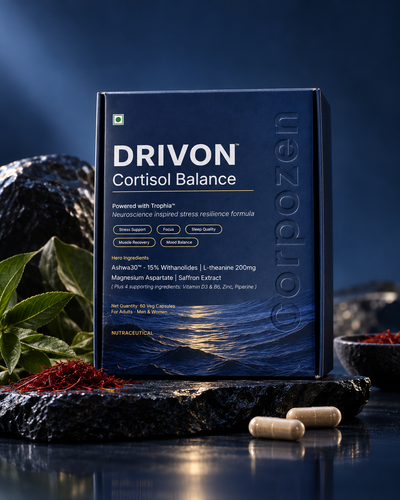
- 200 mg L-theanine, the studied dose, in every serving
- With Ashwa30™, saffron extract and magnesium · caffeine-free
- Money-back guarantee on your first pack
 From Corpozen
Drivon Cortisol Balance
With Ashwa30™, clinically studied to support healthy cortisol levels, plus 200 mg L-theanine for calm focus in every serving.
See what's inside →
Claims are based on scientific literature on the ingredients used.
For general information only. Not a medical test or a substitute for medical advice. Consult a doctor if you are pregnant, nursing, on medication or have a medical condition.