
The world's most faked spice: Saffron extract for mood and sleep, what the trials show
Saffron is the world's most expensive spice, and one of the most faked. Here's what placebo-controlled trials show for mood, stress and sleep, the dose that worked, and how to tell real saffron extract from filler.

On this page
Saffron is the world's most expensive spice. That's exactly why it's also one of the most faked. A 2026 review of saffron fraud found that 20 to 30% of saffron sold worldwide is adulterated, rising to as much as 60% in India. [1] So before asking what saffron can do for your mood or sleep, there's a better first question: is it actually saffron?
- Up to 60% of saffron sold in India may be adulterated, with petals, turmeric or synthetic dyes.
- Real saffron's value comes from three compounds: crocin, picrocrocin and safranal. A standardised extract proves they're there.
- In placebo-controlled trials, saffron extract was linked to better mood, a calmer stress response and better sleep quality in healthy adults.
- Dose matters: 28 mg a day worked, 22 mg didn't. Most positive trials used about 28 to 30 mg.
Real saffron is three compounds, not a colour
Saffron comes from the red stigmas, the thin threads, of the Crocus sativus flower. Each flower has just three, picked by hand, which is why saffron costs what it does.
Its effects come from three natural compounds, measured in labs to judge saffron quality: [2]
- Crocin: the pigment behind saffron's deep red-gold colour.
- Picrocrocin: the source of its bitter taste.
- Safranal: the source of its aroma, and a common marker for standardising extracts.
Colour alone proves nothing. Fake saffron is designed to look right; it just doesn't contain these compounds in meaningful amounts.
Why saffron is the world's most faked spice
When a spice costs more by weight than almost anything in your kitchen, faking it pays. The 2026 review identified the most common tricks: [1]
- Substitution with cheaper look-alikes such as safflower or marigold petals, or turmeric.
- Dilution with other parts of the plant or unrelated plant material.
- Synthetic dyes, including Sudan dyes and auramine-O, added to fake the colour. These raise real safety concerns, not just a lower-quality product.

A standardised extract solves the fake-saffron problem
A standardised saffron extract is tested so that every batch contains a set percentage of a marker compound, usually safranal or crocin. Labs measure these with methods like HPLC, which can also flag adulteration. [2]
That number on the label does two jobs. It proves the extract comes from real saffron, and it means the dose you take today is the same as the dose you took last month.
"With saffron, the question isn't just how much. It's whether it's real, and how much of it is active."
What the trials found
Saffron extract has been studied in randomised, double-blind, placebo-controlled trials, mostly in healthy adults going through ordinary pressure, low mood or poor sleep.
Mood over four weeks. 128 healthy adults with self-reported low mood took a saffron extract at 28 mg or 22 mg a day, or a placebo. At 28 mg, mood improved compared with placebo. At 22 mg, there was no difference. [3]
Mood over eight weeks. 56 healthy adults took 30 mg of a standardised saffron extract or a placebo. The saffron group reported improvements in mood scores and in social relationships. [4]
A single dose before a stress test. Healthy young men took 30 mg of saffron extract or a placebo, then did a standard lab stress test. With saffron, they rated their stress lower, and their salivary cortisol peaked later than with placebo. [5]
Sleep quality over four weeks. 63 healthy adults with self-reported poor sleep took 28 mg of saffron extract a day or a placebo. The saffron group reported greater improvements in sleep quality, with no reported side effects. [6] A meta-analysis of randomised trials also found saffron was linked to better sleep quality scores. [7]

The honest picture: these trials are mostly small to mid-sized, several were funded by extract makers, and they measured how people felt using validated questionnaires. Together, though, they point consistently in the same direction at around 28 to 30 mg a day.
How to choose a saffron supplement

Where Drivon fits
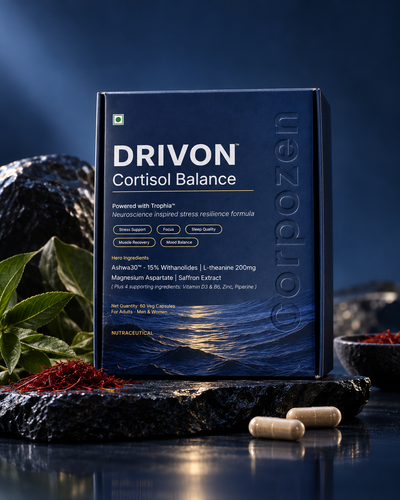
Every serving of Drivon contains 30 mg of saffron extract: the dose range used across these trials, with a Certificate of Analysis for every batch. It's one of Drivon's core four, alongside 30 mg of Ashwa30™, 200 mg of L-theanine and magnesium aspartate.
Saffron extract supports mood balance, alongside Ashwa30™ and L-theanine, studied to support a healthy stress response and calm focus. Drivon is caffeine-free and taken once a day with breakfast or lunch.
- 30 mg saffron extract, a dose used in mood trials
- With Ashwa30™, 200 mg L-theanine and magnesium aspartate
- Money-back guarantee on your first pack
Frequently asked questions
Is saffron extract the same as kesar?
Kesar is saffron. A saffron extract is a concentrated form made from the stigmas and standardised to a set level of active compounds, so each dose is consistent. Loose kesar varies in strength and, in India, is often adulterated. [1, 2]
How much saffron extract should I take?
Most positive trials used about 28 to 30 mg of standardised extract a day. In one trial, 28 mg improved mood while 22 mg did not. [3–6] Drivon contains 30 mg.
What does "standardised" mean for saffron extract?
A standardised extract is tested so that every batch contains a set level of a marker compound, usually safranal or crocin. It shows the extract comes from real saffron and keeps the strength consistent from batch to batch. Look for the percentage on the label, or a batch Certificate of Analysis that confirms it. [2]
How long does saffron take to work?
In the trials, people took saffron extract daily for 4 to 8 weeks before results were measured. [3, 4, 6] It's meant for consistent daily use, and individual responses vary.
Is it safe to take saffron extract every day?
At around 30 mg a day, saffron extract was well tolerated in these trials. [3, 6] If you're pregnant or nursing, or take regular medication, check with a doctor first.
Sources
- Mehdizadeh M, et al. Combating saffron fraud: a systematic review of adulteration practices, detection technologies, recommendations and challenges. Critical Reviews in Food Science and Nutrition. 2026. PubMed 40792566
- Eghbali S, et al. An overview of analytical methods employed for quality assessment of Crocus sativus (saffron). Food Chemistry: X. 2023. PubMed 38144850
- Kell G, et al. affron®, a novel saffron extract (Crocus sativus L.), improves mood in healthy adults over 4 weeks in a double-blind, parallel, randomized, placebo-controlled clinical trial. Complementary Therapies in Medicine. 2017. PubMed 28735826
- Jackson PA, et al. Effects of saffron extract supplementation on mood, well-being, and response to a psychosocial stressor in healthy adults: a randomized, double-blind, parallel group, clinical trial. Frontiers in Nutrition. 2021. PubMed 33598475
- Pouchieu C, et al. Acute effect of a saffron extract (Safr'Inside™) and its main volatile compound on the stress response in healthy young men: a randomized, double-blind, placebo-controlled, crossover study. Nutrients. 2023. PubMed 37447245
- Lopresti AL, et al. Effects of saffron on sleep quality in healthy adults with self-reported poor sleep: a randomized, double-blind, placebo-controlled trial. Journal of Clinical Sleep Medicine. 2020. PubMed 32056539
- Lian J, et al. Effects of saffron supplementation on improving sleep quality: a meta-analysis of randomized controlled trials. Sleep Medicine. 2022. PubMed 35325766
- 200 mg L-theanine, the studied dose, in every serving
- With Ashwa30™, saffron extract and magnesium · caffeine-free
- Money-back guarantee on your first pack
 From Corpozen
Drivon Cortisol Balance
With Ashwa30™, clinically studied to support healthy cortisol levels, plus 200 mg L-theanine for calm focus in every serving.
See what's inside →
Claims are based on scientific literature on the ingredients used.
For general information only. Not a medical test or a substitute for medical advice. Consult a doctor if you are pregnant, nursing, on medication or have a medical condition.