
900 mg isn't 900 mg: Magnesium forms, labels and absorption, explained
The biggest number on your magnesium label often isn't the magnesium. Here's how to read the label in ten seconds, which forms the studies say absorb best, and how much you actually need.

On this page
Most people buy magnesium by the biggest number on the label. That number often isn't the magnesium. Sometimes it's the weight of the whole compound. Sometimes it's real magnesium in a form your body barely absorbs. Here's how to tell the difference in ten seconds, and what the studies say about each form.
- Look for the elemental magnesium number. A "1,000 mg magnesium glycinate" label gives you only about 140 mg of magnesium.
- Magnesium oxide is the cheapest form and the most poorly absorbed: about 4% in one study.
- Glycinate and aspartate are both premium amino-acid forms. Glycinate suits evenings; aspartate suits the daytime.
- Smaller daily amounts taken with a meal are absorbed more efficiently than one big dose.
Magnesium is a mineral your stress response runs on
Magnesium is involved in hundreds of processes in the body, including normal nerve and muscle function and energy production. It also plays a role in regulating your normal stress response. [5]
Researchers have described a two-way link here: stress may increase how much magnesium the body loses, and low magnesium status may make the body more reactive to stress. They call it the magnesium and stress vicious circle. [5] For anyone living through long, high-pressure workdays, that makes getting enough magnesium, in a form you actually absorb, worth getting right.
The label trap: compound weight vs real magnesium
Magnesium can't be put in a capsule on its own. It's always bound to a partner molecule, such as oxide, citrate, glycinate or aspartate. That partner has weight too, so the compound weighs much more than the magnesium inside it.
Labels show this in two ways, and only one tells you what you're getting:
- "Magnesium bisglycinate 1,000 mg": the weight of the whole compound. Only about 14% of it is magnesium, so you get roughly 140 mg.
- "Magnesium (as oxide) 400 mg": this is elemental magnesium, the real amount. But the form matters too, as you'll see next.

Oxide is cheap because it barely absorbs
Magnesium oxide packs the most magnesium per milligram, about 60%, which is why it shows up in budget products with impressive numbers. The catch is absorption.
- When researchers compared four forms in healthy volunteers, only about 4% of magnesium oxide was absorbed. Chloride, lactate and aspartate were all absorbed significantly better, and equally well. [1]
- Oxide was virtually insoluble in water and only 43% soluble even in stomach-acid conditions, while citrate dissolved far more readily. [2]
- In a 60-day placebo-controlled trial, magnesium oxide produced no measurable difference from placebo, while citrate and an amino-acid chelate were absorbed better. [3]
The premium tier: magnesium bound to an amino acid
Glycinate and aspartate belong to the same top tier. In both, magnesium is bound to an amino acid: glycine in glycinate, aspartic acid in aspartate. These amino-acid forms absorbed better than oxide in head-to-head testing. [1, 3]
They also carry less magnesium by weight, because the amino-acid partner is heavier. That lower percentage is the price of a well-absorbed form, not a sign of a weaker one. It's also why the compound number on these labels is so much bigger than the magnesium inside.
"A lower percentage of magnesium isn't a weaker form. It's the price of a well-absorbed one."

| Form | What the studies found |
|---|---|
|
Oxide Budget · ~60% magnesium |
About 4% absorbed in one study; no different from placebo in another [1, 3] |
|
Citrate Organic salt · ~16% |
More soluble and better absorbed than oxide [2, 3] |
|
Glycinate Amino-acid form · ~14% |
Amino-acid chelates absorbed better than oxide; usually an evening form [3] |
|
Aspartate Amino-acid form · ~8–10% |
Absorbed as well as chloride and lactate, and significantly better than oxide; suits daytime formulas [1] |
Daytime or evening: the partner molecule decides
Since glycinate and aspartate both absorb well, the real difference between them is the partner molecule, and when you take it.
- Glycinate is usually an evening form. Its partner, glycine, has been studied as a bedtime supplement: in one trial, people who took 3 g of glycine before bed reported less fatigue the next day. [8] That's why glycinate is mostly sold for night-time routines.
- Aspartate suits the daytime. Its partner, aspartic acid, is an amino acid your body uses in everyday energy metabolism, which is why aspartate is a common choice for daytime formulas.
Drivon follows the same logic. It's a daytime formula, taken with breakfast or lunch, so it uses magnesium aspartate.
How you take it matters as much as the form
A 2017 review of magnesium absorption found three practical rules that are easy to miss: [4]
- Smaller amounts absorb better. The body absorbs a higher share of magnesium from smaller doses spread over the day than from one large dose.
- Food helps. Protein in a meal can improve magnesium uptake, while very high doses of other minerals can compete with it.
- Consistency beats megadoses. The body doesn't store extra magnesium for later. When you absorb more than you need, you excrete more. A steady daily intake works with that.
How much magnesium you actually need
India's latest dietary guidelines set the recommended daily allowance at 440 mg a day for men and 370 mg for women. [7] Most of it should come from food: pulses like rajma and chana, nuts, seeds, whole grains and leafy greens.
A supplement's job is to top up your diet with magnesium your body can actually use. So the number to judge isn't the one on the front of the pack; it's how much of it you absorb.

How to choose and take a magnesium supplement
Where Drivon fits
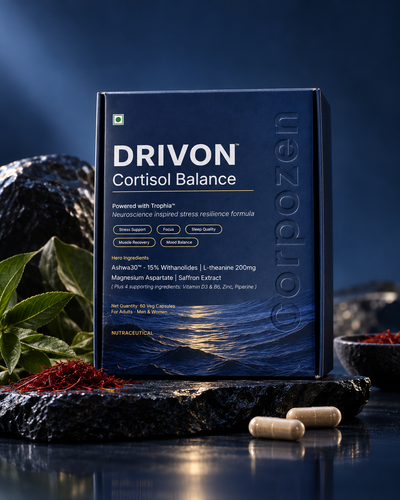
Drivon uses magnesium aspartate, an amino-acid form from the premium tier, chosen because Drivon is a daytime formula. Our label shows both numbers: 900 mg of magnesium aspartate, giving 90 mg of elemental magnesium. It's a moderate daily top-up, taken with a meal, designed to sit alongside a good diet rather than replace it.
It's paired with vitamin B6 (as pyridoxine hydrochloride), a combination researchers have studied together for stress, [6] plus 200 mg of L-theanine, Ashwa30™ ashwagandha and saffron extract. No magnesium oxide, no proprietary blends, and every dose is on the label. Drivon is caffeine-free, with ingredients studied to support a healthy stress response through demanding workdays.
- 90 mg elemental magnesium as aspartate, a premium amino-acid form
- With vitamin B6, 200 mg L-theanine, Ashwa30™ and saffron extract
- Money-back guarantee on your first pack
Frequently asked questions
Is magnesium aspartate as good as magnesium glycinate?
Yes, they're in the same premium tier: both bind magnesium to an amino acid. In a head-to-head study, aspartate absorbed as well as chloride and lactate, and significantly better than oxide. [1] The main difference is timing: glycinate is usually an evening form, while aspartate suits a daytime formula like Drivon.
Why does Drivon list 900 mg and 90 mg of magnesium?
900 mg is the weight of the magnesium aspartate compound. 90 mg is the elemental magnesium inside it, the amount your body can actually use. We show both so you can compare products honestly.
How much magnesium do I need a day?
India's dietary guidelines recommend 440 mg a day for men and 370 mg for women. [7] Most of it should come from food, with a supplement as a top-up.
Should I take magnesium in the morning or at night?
For absorption, consistency and taking it with a meal matter more than the time of day. [4] Drivon is designed to be taken with breakfast or lunch, every day.
Is it safe to take magnesium every day?
Moderate daily amounts from supplements are generally well tolerated by healthy adults. Higher amounts, especially of some forms, can loosen stools. If you have kidney problems or take medication, check with a doctor first.
Sources
- Firoz M, Graber M. Bioavailability of US commercial magnesium preparations. Magnesium Research. 2001. PubMed 11794633
- Lindberg JS, et al. Magnesium bioavailability from magnesium citrate and magnesium oxide. Journal of the American College of Nutrition. 1990. PubMed 2407766
- Walker AF, et al. Mg citrate found more bioavailable than other Mg preparations in a randomised, double-blind study. Magnesium Research. 2003. PubMed 14596323
- Schuchardt JP, Hahn A. Intestinal absorption and factors influencing bioavailability of magnesium: an update. Current Nutrition & Food Science. 2017. PubMed 29123461
- Pickering G, et al. Magnesium status and stress: the vicious circle concept revisited. Nutrients. 2020. PubMed 33260549
- Pouteau E, et al. Superiority of magnesium and vitamin B6 over magnesium alone on severe stress in healthy adults with low magnesemia: a randomized, single-blind clinical trial. PLoS One. 2018. PubMed 30562392
- ICMR–National Institute of Nutrition. Nutrient requirements for Indians: recommended dietary allowances and estimated average requirements. 2020.
- Bannai M, et al. The effects of glycine on subjective daytime performance in partially sleep-restricted healthy volunteers. Frontiers in Neurology. 2012. PubMed 22529837
- 200 mg L-theanine, the studied dose, in every serving
- With Ashwa30™, saffron extract and magnesium · caffeine-free
- Money-back guarantee on your first pack
 From Corpozen
Drivon Cortisol Balance
With Ashwa30™, clinically studied to support healthy cortisol levels, plus 200 mg L-theanine for calm focus in every serving.
See what's inside →
Claims are based on scientific literature on the ingredients used.
For general information only. Not a medical test or a substitute for medical advice. Consult a doctor if you are pregnant, nursing, on medication or have a medical condition.